
What Can You Put in a Coffin? Burial, Cremation and Natural Burial Rules Compared
 runppcseo
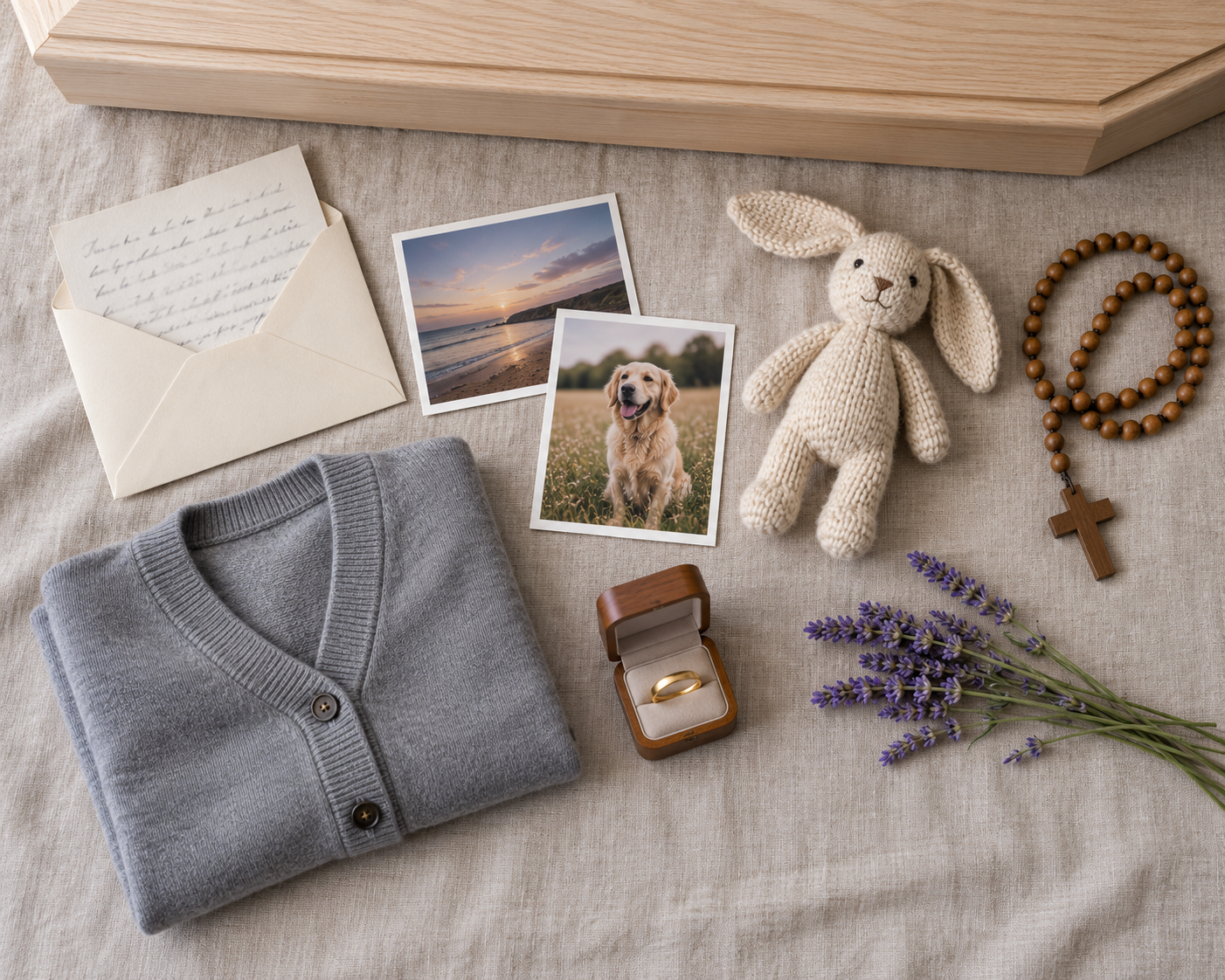
You can usually place small, meaningful items in a coffin, such as letters, photographs and flowers. How much more you can include depends on the type of funeral:
- Burial: the fewest restrictions. Most personal items are accepted.
- Cremation: stricter rules. Glass, plastic, metal and anything that could be harmful or explode must stay out, and clothing should be natural fibres.
- Natural or woodland burial: everything must be biodegradable, including clothing and the coffin itself.
Rules vary between crematoria, burial grounds and funeral directors, so always check with your funeral director before the funeral.
Burial, cremation and natural burial compared
| Item | Burial | Cremation | Natural burial |
|---|---|---|---|
| Letters, cards and drawings | Usually allowed | Usually allowed | Usually allowed (plain paper) |
| Photographs | Usually allowed | Usually allowed | Check with the burial ground |
| Fresh flowers | Usually allowed | Usually allowed | Usually allowed |
| Soft toys | Usually allowed | Often allowed, if natural materials | Natural materials only |
| Jewellery | Allowed, but cannot be recovered | Allowed by some, but cannot be recovered | Check with the burial ground |
| Religious items | Usually allowed | Wooden items are often accepted | Natural materials only |
| Glass and plastic items | Usually allowed | Not allowed | Not allowed |
| Bottles of alcohol | Usually allowed | Not allowed | Not allowed |
| Batteries and electronic items | Check with your funeral director | Not allowed | Not allowed |
| Synthetic clothing and shoes | Usually allowed | Avoid PVC, vinyl, latex and treated leather | Not allowed |
What you can put in a coffin for cremation
Crematoria need everything in the coffin to burn safely and cleanly. The Federation of Burial and Cremation Authorities instructs funeral directors that:
- additional items, particularly of glass or plastic, should not be placed in the coffin
- clothing should be made from natural fibres, and shoes or anything made from PVC should not be included
- copper body adornments and easily removable prostheses should be removed
Items that are usually accepted include letters, photographs, flowers, small natural soft toys and wooden rosary beads.
Some crematoria are stricter still. For example, North Northamptonshire Council’s crematoria allow only letters, flowers and photographs, and ask for light natural clothing such as cotton.
Pacemakers and some other implants are removed before cremation, as they can explode under heat. Your funeral director or the doctor completing the cremation paperwork will deal with this.
What happens to jewellery?
Jewellery placed in a coffin cannot be recovered, whether the funeral is a burial or a cremation. If a ring or watch has sentimental or financial value, many families choose to keep it or pass it on and place a photograph or letter in the coffin instead.
If jewellery is to stay on, tell your funeral director in writing so they know your wishes.
What to dress someone in for a cremation
Natural fibres such as cotton, wool, linen and silk are the safest choice. Avoid synthetic fabrics such as fleece and nylon, and shoes with plastic or rubber soles. Some families choose a simple gown or shroud instead.
Natural and woodland burial rules
Natural burial grounds aim for everything to return to the earth. That means:
- clothing and any items in the coffin must be made from natural, biodegradable materials
- the coffin itself must be biodegradable, with no plastic fittings or synthetic linings
- some grounds also restrict embalming
Our guide to coffins for natural burial covers the materials most burial grounds accept, such as willow, bamboo, cardboard and untreated wood.
Your choice of coffin matters too
The rules for what goes inside a coffin are part of the same rules that apply to the coffin itself. For a cremation, the coffin must be made from materials that burn safely, with no metal fittings beyond what is needed for construction. Our guide to cremation coffins explains which materials and finishes crematoria accept.
If you are planning a direct cremation, check the provider’s policy on personal items early. Some packages do not allow any items, or your loved one’s own clothes, to be placed in the coffin. Our guide to direct cremation and choosing a coffin explains your options.
How to make sure your wishes are followed
- Make a list of the items you would like to include.
- Give it to your funeral director early, ideally in writing.
- Ask what the crematorium or burial ground allows, as rules differ.
- Decide about jewellery before the funeral.
- Ask what happens to anything that is not allowed. Items that are removed are usually returned to the family.
Choosing a coffin with Compare the Coffin
Compare the Coffin helps families choose and buy a coffin online, with delivery to their funeral director. Browse coffins for cremation, coffins for burial and coffins for natural burial.
Frequently asked questions
Can you put a phone in a coffin?
Not for a cremation, because phones contain batteries that can explode. For a burial, ask your funeral director.
Can you be buried with your wedding ring?
Yes. Many people are buried with their wedding ring, but it cannot be recovered afterwards.
Can you put ashes in a coffin?
For a burial, the ashes of a loved one can often be placed in the coffin. Check with your funeral director and the burial ground first.
Can children put drawings or toys in the coffin?
Yes. Drawings, letters and small soft toys are among the most common items. For a cremation or natural burial, choose toys made from natural materials.
What happens to items that are not allowed?
Your funeral director will usually remove them before the funeral and return them to you.
Recommended Posts
Types of Coffins: Materials, Prices and Suitability Compared
September 25, 2026
Coffin or Casket? The Difference, and Which Suits a UK Funeral
September 25, 2026
Are Fabric Coffins Suitable for Burial or Cremation? Complete Guide
September 18, 2026